
You found the space.
You signed the lease.
You can already picture your business operating there.
There’s just one problem.
The space doesn’t actually work for your business yet.
Maybe you’re opening a new retail location. Perhaps your office needs a completely different layout. Your restaurant needs renovations. Your company has outgrown its existing space. Or you’ve leased a previously occupied property that needs to be transformed before customers ever walk through the door.
That’s where the commercial build-out begins.
At Top Notch Carpentry, LLC, we’ve worked on commercial projects ranging from retail and franchise locations to grocery stores, office buildings, hospitality, multifamily and specialty spaces throughout the Memphis area. We’ve also partnered with general contractors as a commercial subcontractor. Top Notch Carpentry
While every project is different, understanding the process before construction begins can help business owners make better decisions and avoid unnecessary surprises.
Here’s what to expect.
First, What Exactly Is a Commercial Build-Out?
A commercial build-out is the construction or renovation required to make a commercial property work for a particular business or tenant.
Imagine leasing an empty shell.
It may have four walls and utilities, but your business needs offices, a reception area, doors, ceilings, cabinetry, flooring and other finishes.
Or perhaps you’re taking over an existing retail location.
The previous tenant’s layout worked perfectly for their operation.
It doesn’t necessarily work for yours.
A build-out transforms that space to accommodate the new business.
Depending on the property and intended use, that can include everything from relatively minor finish upgrades to a substantial interior reconstruction.
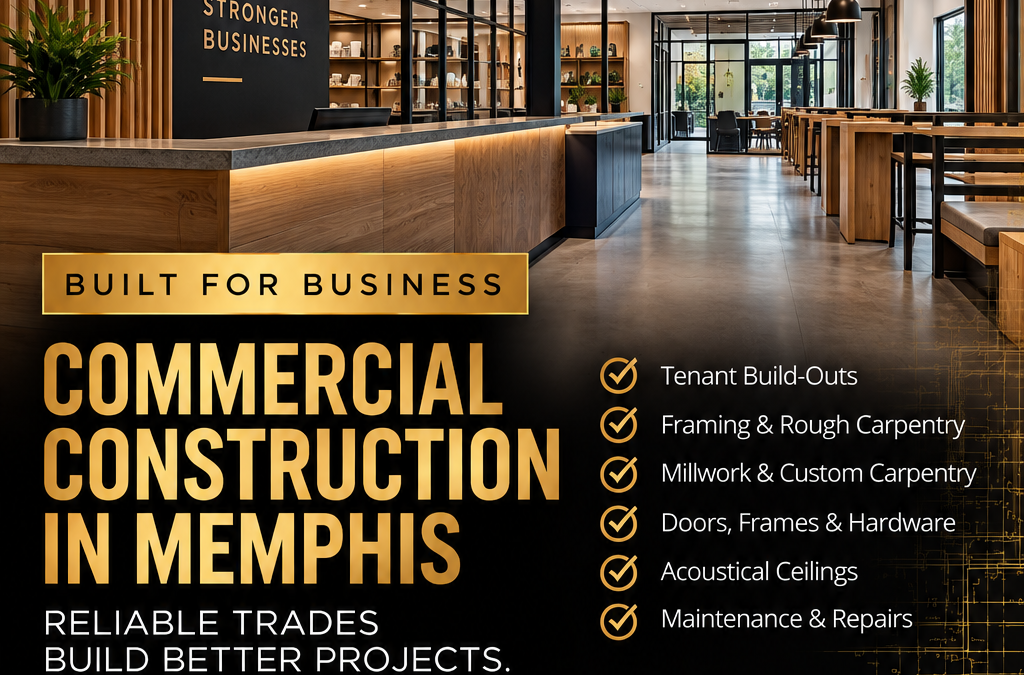
Top Notch’s commercial remodeling capabilities include tenant build-outs, expansions, office buildings, restaurant remodels, bathrooms, industrial buildings, accessibility remodels, special-purpose rooms and layout reconfiguration. Top Notch Carpentry
- Start With How the Business Needs to Function
Before talking about paint colors and finishes, think about operations.
How will customers enter?
Where will employees work?
How does inventory move through the building?
Where is storage needed?
Which spaces need privacy?
What areas experience the most traffic?
Where will equipment be located?
The best-looking commercial space in Memphis isn’t particularly useful if employees can’t work efficiently inside it.
That’s why commercial construction should begin with function first and aesthetics second.
Once the operational requirements are understood, the construction team can determine how the physical space needs to support them.
- Understand the Existing Conditions
One of the biggest variables in commercial remodeling is what already exists.
A previously occupied building can contain surprises.
Walls may conceal old utilities.
Existing framing may need modification.
Previous improvements may not work with the new layout.
Doors or restrooms may need accessibility upgrades.
Electrical or mechanical systems may need modifications to accommodate new equipment.
That’s why evaluating the existing conditions before developing the final construction scope is so important.
The more information available at the beginning, the more accurately the project can be planned.
- Establish the Scope Before Comparing Prices
This is where commercial construction bids can become confusing.
Imagine receiving three proposals:
Contractor A: $70,000
Contractor B: $88,000
Contractor C: $105,000
Contractor A looks like the obvious choice.
Except Contractor A didn’t include several items contained in the other proposals.
Now you’re not comparing three prices for the same project.
You’re comparing three different scopes of work.
When reviewing proposals, pay close attention to what’s included, excluded, provided by the owner or performed by another trade.
Clarifying scope early can help prevent the phrase nobody wants to hear halfway through construction:
“That wasn’t included.”
- Commercial Construction Involves a Lot of Moving Pieces
Even a relatively straightforward build-out can involve multiple trades.
Framing.
Electrical.
Plumbing.
HVAC.
Drywall.
Doors and hardware.
Ceilings.
Flooring.
Cabinetry.
Millwork.
Finish carpentry.
Each piece may depend on another being completed first.
For example, cabinetry installation may depend on walls and flooring being ready. Ceiling work may need coordination with lighting, sprinklers and mechanical systems.
Good scheduling isn’t simply about getting people onto the jobsite quickly.
It’s about getting the right trade there at the right time.
- Permits and Inspections Need to Be Part of the Schedule
Commercial construction often requires permits and inspections, depending on the scope and jurisdiction.
Those requirements shouldn’t be treated as an afterthought.
They need to be incorporated into the project schedule from the beginning because certain work may need inspection before subsequent construction can continue.
Business owners should discuss permitting responsibility with their contractor early so everyone understands who is obtaining required permits, coordinating inspections and handling associated documentation.
- Accessibility Matters
Commercial spaces must also consider accessibility requirements.
That can affect features such as entrances, routes through the building, doors, restrooms, ramps and other elements of the space.
Top Notch includes ADA compliance and accessibility work among its commercial services. Top Notch Carpentry
Addressing accessibility during planning is far easier than discovering after construction that completed work needs to be modified.
- Branding Can Become Part of the Physical Space
Here’s where commercial construction gets interesting.
Your space can actually reinforce your brand.
A retail store shouldn’t necessarily feel like an accounting office.
A boutique shouldn’t feel like a warehouse.
A restaurant shouldn’t feel like a medical office.
The materials, millwork, displays, cabinetry, shelving and architectural details can all contribute to the customer experience.
Top Notch’s commercial custom work includes cabinets, storage rooms, displays and shelving, custom entryways, exterior spaces and other carpentry elements. Top Notch Carpentry
That’s where custom carpentry can transform a commercial space from simply functional into something memorable.
- Operating During Construction Requires Extra Planning
Sometimes a commercial renovation happens while the business remains open.
That adds another level of complexity.
Customers and employees still need access.
Construction areas need to remain controlled.
Deliveries may need to occur at specific times.
Noise and dust need to be managed.
Certain work may need to happen outside normal operating hours.
Top Notch specifically notes that expanding or remodeling an occupied commercial property can be challenging and that determining the appropriate construction approach with the client is part of the process. Top Notch Carpentry
If your business needs to remain operational during construction, make that clear during the earliest planning conversations.
- Expect Changes—But Document Them
Commercial projects change.
A hidden condition is discovered.
The owner changes a finish.
Equipment specifications change.
Additional work becomes necessary.
The important part is documenting those changes.
Before additional work proceeds, everyone should understand:
What is changing?
What will it cost?
Will it affect the schedule?
That’s what a good change-order process accomplishes.
Verbal conversations may happen quickly on a jobsite, but changes affecting cost or schedule should ultimately be documented.
- The Punch List Is Part of the Process
As construction nears completion, the contractor and client typically review the work and identify remaining items requiring attention.
That’s the punch list.
Maybe a piece of trim needs adjustment.
A door needs alignment.
Paint needs touching up.
Hardware needs adjustment.
A finish needs correction.
The existence of a punch list doesn’t automatically mean something went wrong.
It’s a normal part of bringing many individual components together into one finished project.
What matters is how those items are addressed.
One of Top Notch’s stated company values is straightforward:
Integrity means leaving no job unfinished and providing the type of customer service the company itself would expect to receive. Top Notch Carpentry
That’s a philosophy worth bringing to every punch list.
Beyond the Build-Out: What Happens After Construction?
A commercial property doesn’t stop requiring attention once the renovation is complete.
High-traffic environments take abuse.
Doors need adjustments.
Finishes become damaged.
Fixtures break.
Exterior areas need repair.
New operational needs emerge.
That’s why commercial maintenance can become an important part of the relationship between a business or property manager and its contractor.
Top Notch offers commercial repair and maintenance services, including scheduled maintenance, general repairs, commercial maintenance contracts, insurance repairs, investment-property maintenance and emergency maintenance services. Top Notch Carpentry
For businesses with multiple locations or property managers responsible for multiple facilities, having a contractor already familiar with your standards can be particularly valuable.
Choosing a Memphis Commercial Contractor
Before hiring a contractor for your commercial project, look beyond whether they can simply perform the work.
Ask about:
Commercial experience.
Licensing and insurance.
Communication.
Scheduling.
Scope management.
Safety.
Quality control.
Experience coordinating multiple trades.
And perhaps most importantly:
Do they understand that this isn’t simply a construction project?
It’s your business.
Every day the doors can’t open can matter.
Let’s Get Your Business Ready for Business.
Top Notch Carpentry, LLC provides commercial construction, remodeling, installation, maintenance and carpentry services throughout Memphis and the surrounding area.
The company has completed work across retail, franchise, grocery, office, hospitality, multifamily and specialty environments and has worked as a subcontractor for general contractors. Its commercial trade capabilities include finish and rough carpentry, wood and metal framing, millwork, doors/frames/hardware, cabinetry, acoustical ceilings, interior trim and more. Top Notch Carpentry
Top Notch is also a licensed, bonded and insured contractor in Tennessee (BC-A & BC-B license #77394). Top Notch Carpentry
Whether you’re preparing a new location, renovating an existing business or looking for a reliable commercial trade partner:
Let’s build something Top Notch.
Top Notch Carpentry, LLC
📞 901-517-2117
🌐 TopNotchCarpentryLLC.com
Recent Comments