
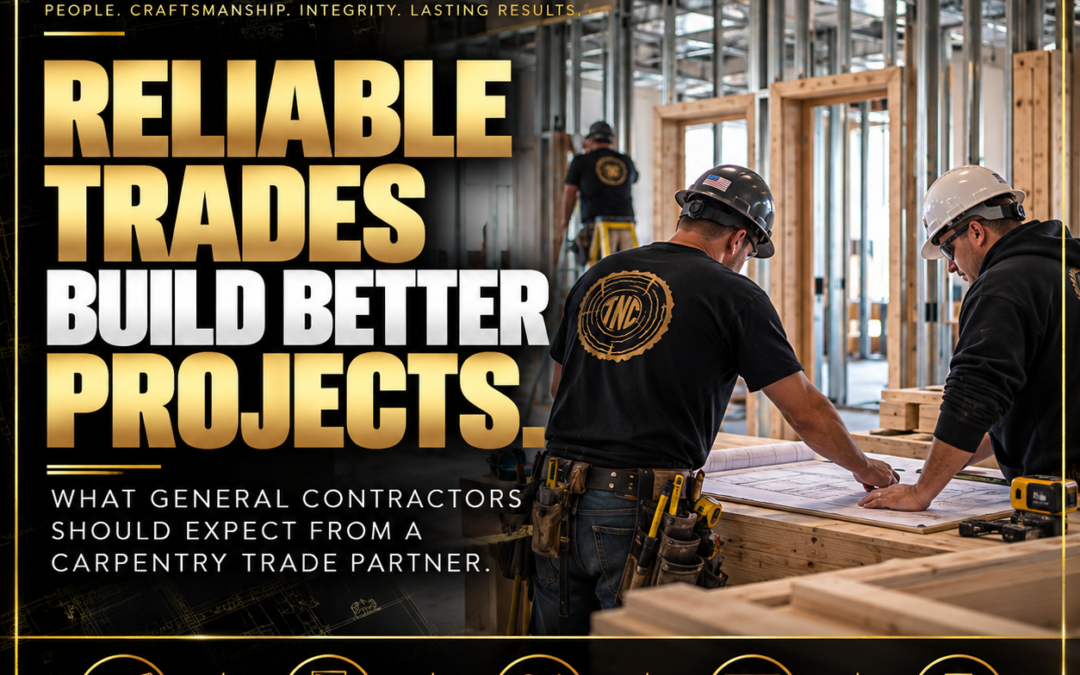
Every general contractor knows the plans are only part of the project.
You can have a solid schedule.
A detailed set of drawings.
A carefully developed budget.
An experienced superintendent.
And a great client.
But ultimately, somebody still has to build it.
That’s where trade partners come in.
The subcontractors working in the field can have a direct impact on quality, schedule, safety and the overall success of a commercial construction project.
And when a reliable trade partner is found?
You remember them.
At Top Notch Carpentry, LLC, we’ve worked as a subcontractor for general contractors on commercial projects while also operating as a residential and commercial general contractor. Our experience spans retail, franchises, grocery stores, offices, hospitality, multifamily and specialty projects. Top Notch Carpentry
We understand what GCs need from their trade partners because we’ve experienced construction from both sides.
Here’s what we believe matters.
- Show Up When You Say You Will
It sounds incredibly basic.
It isn’t.
Commercial construction schedules are interconnected.
One trade’s work often needs to be completed before another can begin.
If framing falls behind, drywall can be affected.
If openings aren’t ready, door installation can be affected.
If millwork isn’t completed, other finish activities can be delayed.
One missed commitment can ripple through several portions of the schedule.
A good trade partner understands that their schedule doesn’t exist in isolation.
Your completion date affects someone else’s start date.
Reliability isn’t simply being on the jobsite.
It’s understanding your role in the overall construction schedule.
- Read the Drawings Before Starting the Work
The jobsite isn’t the place to discover the project for the first time.
Commercial carpentry can involve architectural drawings, details, elevations, schedules, specifications and manufacturer requirements.
A subcontractor needs to understand what they’re being asked to build.
That includes identifying conflicts or missing information before they become installed problems whenever possible.
Questions aren’t necessarily a bad thing.
In fact, sometimes asking the right question before installation can save significant time and money later.
Top Notch’s expectations for its own carpentry workforce include the ability to accurately read blueprints and technical drawings along with working knowledge of carpentry construction and installation methods. Top Notch Carpentry
That’s not just an employment qualification.
It’s a project requirement.
- Communicate Problems Early
Here’s something no project manager wants:
Finding out Friday afternoon about a problem the subcontractor discovered Tuesday morning.
Construction issues happen.
Existing conditions don’t match drawings.
Materials arrive damaged.
Dimensions conflict.
Another trade’s work affects yours.
Something isn’t going to fit.
The question isn’t whether every commercial project will be completely problem-free.
The question is:
What happens when there’s a problem?
Reliable trade partners communicate quickly.
They explain what they’ve found.
They document the condition when necessary.
And instead of simply saying:
“We can’t do it.”
They help answer:
“How can we solve it?”
That’s the kind of subcontractor relationship that makes projects easier to manage.
- Understand Your Scope
Scope gaps create problems.
So does performing additional work without clearly communicating that it’s outside the contracted scope.
A strong trade partner understands:
What’s included.
What’s excluded.
What’s an allowance.
What’s someone else’s responsibility.
What constitutes additional work.
When conditions change or additional work is requested, the subcontractor should communicate the potential cost and schedule implications before simply moving forward whenever circumstances allow.
That protects everyone.
The GC knows what to expect.
The subcontractor gets compensated appropriately.
And the owner isn’t surprised later.
- Quality Still Matters When the Schedule Gets Tight
Every construction professional has experienced it.
The project gets close to turnover.
Suddenly everyone needs everything done yesterday.
That’s exactly when quality can start slipping if teams aren’t careful.
But rushing poor workmanship through installation doesn’t necessarily save time.
Sometimes it simply transfers that time to the punch list.
Install.
Inspect.
Remove.
Repair.
Reinstall.
Reinspect.
That’s not efficient.
Top Notch’s company values specifically emphasize quality and attention to detail, while its commercial capabilities include both rough and finish-oriented scopes. Top Notch Carpentry
We believe quality control should happen during installation, not just at the end of the project.
- Know the Difference Between Rough and Finish Work
Commercial carpentry can cover a surprisingly broad scope.
Top Notch’s listed capabilities include:
Finish carpentry
Rough carpentry
Wood and metal framing
Doors, frames and hardware
Millwork installation
Interior trim packages
Acoustical ceilings
Custom cabinets
Custom carpentry
Wood and vinyl windows
Accessibility work
and other commercial installations. Top Notch Carpentry
Each scope requires different skills.
Framing is about creating accurate structure and layout.
Finish carpentry requires precision in visible details.
Doors and hardware require careful installation and adjustment.
Millwork requires coordination between field conditions, fabricated components and the surrounding finishes.
A good carpentry subcontractor understands the difference—and staffs the work accordingly.
- Don’t Underestimate Professionalism
Commercial construction is demanding.
Schedules change.
Pressure increases.
Problems occur.
People disagree.
Professionalism matters most when things aren’t going perfectly.
A strong trade partner should be able to communicate respectfully with:
Project managers.
Superintendents.
Other subcontractors.
Owners.
Architects.
Vendors.
Inspectors.
And anyone else involved in getting the project across the finish line.
You don’t need another problem to manage.
You need another member of the project team.
- Safety Is Part of Being a Professional Trade Partner
Getting the work completed matters.
Getting everyone home safely matters more.
A professional subcontractor should understand jobsite safety expectations and ensure employees receive appropriate orientation and education.
Top Notch identifies safety as a company priority and provides safety education and orientation as part of its workforce program. Top Notch Carpentry
Safety shouldn’t be treated as something separate from productivity.
It’s part of professional construction operations.
- Skilled Labor Matters
Commercial contractors across the industry understand the value of skilled craftspeople.
Carpentry is learned through education, repetition, mentorship and experience.
Top Notch’s own story is rooted in that process.
Founder Jeremy Hoffman began woodworking in school, started apprenticing in a custom cabinet shop at 15, spent three years working under a Master Carpenter and later joined New York City’s United Brotherhood of Carpenters Local 157. His experience included finish carpentry, metal framing, windows and doors, flooring and ceilings before eventually founding Top Notch in Memphis. Top Notch Carpentry
That respect for the trade continues today.
Top Notch says it provides on-the-job training and has developed a mentoring and training program for experienced craftspeople, people interested in learning the trade and individuals considering a career change. Top Notch Carpentry
Because the construction industry doesn’t simply need more workers.
It needs skilled workers.
- The Best Trade Relationships Extend Beyond One Project
One successful project is great.
But one of the real advantages of building relationships with reliable subcontractors is what happens on the next project.
And the project after that.
The teams understand one another.
Communication becomes easier.
Expectations are clearer.
The subcontractor understands the GC’s procedures.
The GC understands the subcontractor’s capabilities.
There’s less uncertainty.
That doesn’t mean performance stops mattering.
Quite the opposite.
Repeat work is earned project by project.
A Good Trade Partner Protects More Than Their Own Reputation
When a subcontractor works on a general contractor’s project, they’re representing more than themselves.
Their performance affects the GC’s relationship with the owner.
Their quality affects the finished product the GC delivers.
Their schedule affects the project’s milestones.
Their conduct affects the jobsite.
Their punch-list performance affects turnover.
That’s why choosing subcontractors based solely on the lowest number can become expensive.
Price matters.
But so do:
Scope.
Experience.
Capacity.
Communication.
Safety.
Quality.
Schedule performance.
Professionalism.
Because the goal isn’t simply to award a subcontract.
The goal is to successfully complete the project.
Looking for a Commercial Carpentry Trade Partner in Memphis?
Top Notch Carpentry, LLC provides commercial carpentry and construction services throughout Memphis and the surrounding area and has worked as a subcontractor for general contractors on projects across retail, franchise, grocery, office, hospitality, multifamily and specialty sectors. Top Notch Carpentry
Our commercial capabilities include finish carpentry, rough carpentry, wood and metal framing, doors/frames/hardware, millwork installation, interior trim packages, acoustical ceilings, cabinetry and custom carpentry. Top Notch Carpentry
Top Notch is a licensed, bonded and insured Tennessee contractor (BC-A & BC-B license #77394). Top Notch Carpentry
Need pricing on an upcoming project?
Send us the plans. Let’s talk scope.
Top Notch Carpentry, LLC
📞 901-517-2117
✉️ info@topnotchcarpentryllc.com
🌐 TopNotchCarpentryLLC.com
Let’s build something Top Notch.
Recent Comments